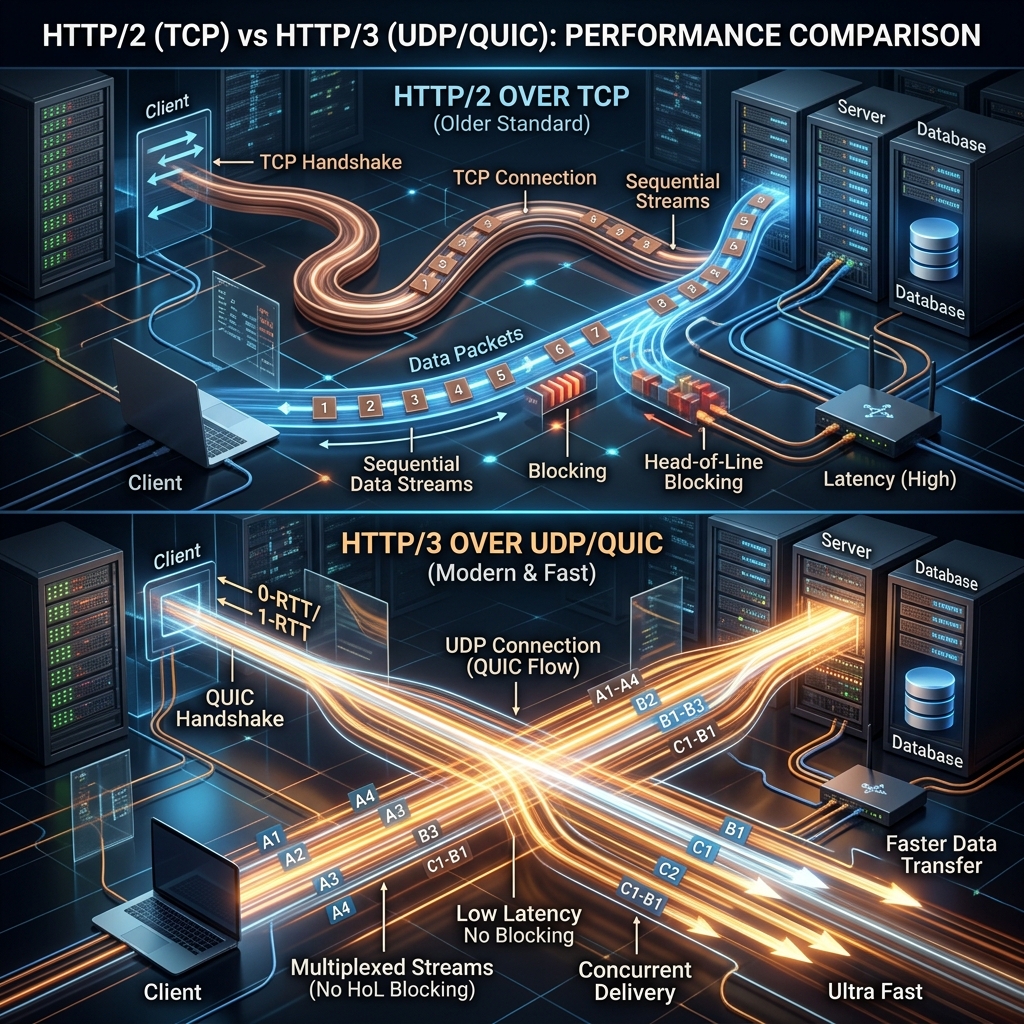
Hypertext Transfer Protocol (HTTP) is the foundation of data exchange on the web. While HTTP/2 brought major performance boosts in 2015 by introducing multiplexing over a single connection, it suffered from a fundamental bottleneck: TCP Head-of-Line (HoL) blocking. HTTP/3 resolves this issue by replacing TCP with a new transport protocol called QUIC (Quick UDP Internet Connections).
What is TCP Head-of-Line Blocking?
In HTTP/2, multiple resources (images, JS, CSS) are sent concurrently over a single TCP stream. However, because TCP guarantees packet order, if a single packet is lost in transit, the entire connection is paused until that packet is retransmitted. This is called Head-of-Line blocking and is especially severe on unstable mobile networks.
How HTTP/3 and QUIC Solve It
HTTP/3 operates over UDP using the QUIC protocol. In QUIC, each stream is treated independently at the transport layer. If a packet belonging to one asset (like an image) is lost, only that specific stream is delayed. All other streams continue to stream without interruption, eliminating HoL blocking completely.
0-RTT Handshakes and Faster Connections
QUIC combines the transport connection handshake and the cryptographic TLS 1.3 handshake into a single step. For returning clients, QUIC supports 0-RTT (Zero Round-Trip Time) connections, allowing web data transmission to start immediately in the very first packet, dramatically cutting down connection setup latency.